Ham's have been involved with the space program for a long time. With the first OSCAR satellite, repeaters in orbit and on the space station...the use of satellites is second nature. On 3 Feb 2011 I tried my hand at the technology and made my first satellite contact using the AO-51 Echo satellite. It was exciting to be able to use a satellite over 100 miles high to contact a ham in New Orleans from my base station in Tucson using modest equipment...crossband mode transceiver at 50 watts output to a 1/4 wave ground plane antenna.
Tuesday, February 15, 2011

Monday, February 14, 2011
Low Tide,High Tide
Here is a short clip showing the effect of low and high tide on a dock ramp. Notice not only the change in the incline of the ramp but the water level to the left of the ramp.
Thursday, January 6, 2011
An Archaeoastronomy Technique
This is a technique I developed in 1997 for analyzing possible astronomical alignments at ancient sites. During this time I was involved in archaeoastronomy and visited several ancient sites. I developed this technique to aid in data collection. It used a 3D modeling program, advanced for the time but by today's standard quite primitive. It was the beginning of using photos, digital techniques and planetarium type programs to reconstruct ancient sites and analyze them with great precision. Dr. Carolyn Sumner of the Houston Museum of Natural History in Texas was the only other person using a similar technique. We presented a paper at a AAS meeting. This video clip is from my Introduction to Archaeoastronomy CD available directly from me for a modest fee..
Monday, January 3, 2011
Rainbows are Polarized
Using your polarized sunglasses as an polaroid analyzer, you can easily see that a rainbow is polarized. Scattered electromagnetic radiation is polarized. Using a lens from your sunglasses can reveal a wealth of information about a property of light. Next time you see a rainbow and you happen to have your polarized sunglasses with you, look through one lens at the rainbow and rotate it 90 degrees and you will see the rainbow "disappear"!
Tuesday, December 28, 2010
Comet Tempel 1 / Deep Impact Collision 4 July 2005
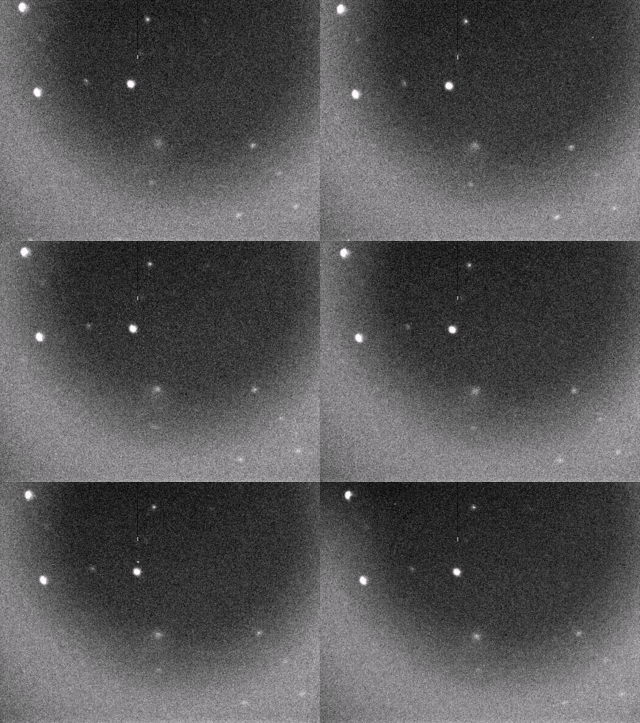
Here is a NASA description of what was to happen during the collision:
A NASA spacecraft named Deep Impact is going to shoot an 820-pound projectile into the rocky, icy nucleus of Comet Tempel 1. The 23,000 mph collision will form a big crater, and Deep impact will observe the stages of its development, how deep it gets and how wide it becomes. Researchers expect a plume of gas and dust to spray out of the crater. Deep Impact will measure its composition and record what the billowing plume does to the comet's atmosphere. In all, Deep Impact should be able to peer into the new crater for almost 15 minutes before the craft speeds away, continuing, like its cometary quarry, to orbit forever around the Sun.
Monday, December 27, 2010
Song of India?
In October of 1995 I traveled to India to view a total solar eclipse. I was excited about being in India. As a child I remembered watching a TV program about an Indian boy and his elephant. He would sing a song to his elephant. I remembered that song and when I got to India I hummed it for my Indian guide. He said he never heard the song and that it was a Hollywood invention. At that moment I decided that if it wasn’t an Indian song it would be before I left. At a village called Gato I assembled several children who were about to witness the eclipse and taught them the song!
Sunday, December 19, 2010
A total lunar eclipse
I flew the night of a total lunar eclipse to show the relative positions of the Sun and Moon as the eclipse began. I was much younger during my flying years...the flight originated from LaCholla Airpark where I kept my plane. Date of the eclipse was 26 September 1996. The video clip is from my Elements of Astronomy cdrom available for purchase at:
http://www.lulu.com/product/cd/elements-of-astronomy/4932003?productTrackingContext=search_results/search_shelf/center/1
http://www.lulu.com/product/cd/elements-of-astronomy/4932003?productTrackingContext=search_results/search_shelf/center/1
Subscribe to:
Posts (Atom)